Recharging batteries is critical to powering the myriad portable devices fueling modern life. Enabling this capability are specialized integrated circuits optimized for safely and efficiently converting power to charge different battery chemistries over time. This deep dive explores battery charger ICs, examining their operating principles, specifications, functions, charging techniques and more.
What is a Battery Charger IC?
A charger IC (Integrated Circuit) is a semiconductor device designed to regulate and control the charging process of batteries or energy storage systems. Sitting at the heart of any external or integrated battery charger, this dedicated system-on-chip performs the multi-faceted role of safely converting alternating or direct current power inputs into precisely regulated direct current suited for battery storage. Primary responsibilities involve monitoring battery status, limiting current draw based on voltage levels, terminating charge when full, and protecting against overcharging or overheating conditions through built-in firmware. It incorporates various functionalities and circuitry to efficiently and safely manage the charging of batteries, ensuring optimal performance and extending their lifespan.
Typically, a charger IC integrates multiple components and features into a single package, including voltage regulation, current regulation, charge termination, thermal management, and various protection mechanisms. It serves as a sophisticated control system that monitors and adjusts the charging parameters according to the specific characteristics and requirements of the battery being charged.
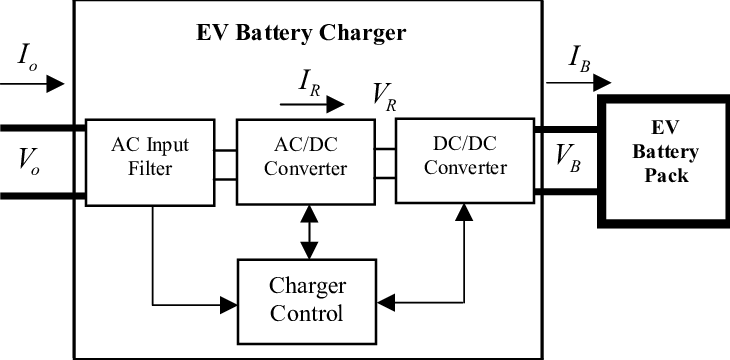
From the Internet - EV battery charger Pack
Principles of Operation
The principle of a battery charger IC to identify battery insertion typically involves monitoring certain electrical characteristics to detect the presence of a battery and initiate the charging process. Here is a general overview of the principles commonly used in battery charger ICs:
● Voltage Detection: Battery charger ICs often employ voltage detection to identify the presence of a battery. When a battery is inserted, its voltage level triggers a voltage detection circuit, indicating the connection.
● Current Detection: Some battery charger ICs incorporate current detection mechanisms to identify the insertion of a battery. When a battery is connected, it draws a certain amount of current, which can be detected by the charger IC. This detection helps initiate the charging process.
● Impedance Detection: Certain battery charger ICs use impedance detection techniques to determine battery insertion. Each type of battery has a unique impedance profile. By measuring the impedance or changes in impedance, the charger IC can identify the battery and proceed with the appropriate charging algorithm.
● Communication Protocols: Advanced battery charger ICs may incorporate communication protocols such as SMBus (System Management Bus) or I2C (Inter-Integrated Circuit) to facilitate battery identification. These protocols allow the charger IC to communicate with the battery and exchange information, including battery type, capacity, and charging requirements.
● Thermal Monitoring: To ensure safe charging, battery charger ICs may also include thermal monitoring capabilities. By monitoring the temperature during battery insertion, the charger IC can verify that the battery is within the acceptable temperature range for charging.
Once the battery charger IC identifies the battery insertion, it can then proceed with the appropriate charging algorithm based on the battery type, capacity, and other relevant factors. The charger IC regulates the charging current and voltage to ensure efficient and safe charging, protecting the battery from overcharging or other potential risks.
Key Specifications
For designers, critical specifications involve supported power delivery, charging modes, battery compatibility, safety certifications, communication interfaces and dimensions. Lithium-ion chargers commonly rate from hundreds of milliamps to multiple amps, while automotive and industrial varieties can push kilowatts. Size also relates to thermal management - smaller footprints require more efficient switching topologies.
Safety validations like UL, EN and IEC approvals give assurance against overcharging, over-current damage or electrical hazards under fault conditions. Programmability allows tailoring charge algorithms specific to battery cell chemistry - whether standard lithium, polymer or specialty alternatives. Interface options range from basic open-drain lines to sophisticated multi-pin USB Type-C Power Delivery controllers.
Types of Charger ICs
Linear Charger ICs
Linear Charger ICs utilize a simple design that directly regulates voltage differences by varying the resistance between the power supply input and battery output. As current is drawn, whatever voltage remains after passing through the internal resistor is delivered to the battery. This works well for low power applications up to around 500mA but wastes excess power as heat through the voltage drop, resulting in lower efficiency typically in the 40-80% range. Examples include the TPS6104x from Texas Instruments, a basic 500mA linear charger popular for simple low-cost devices.
Switching/Buck Charger ICs
Employ a more complex switching regulator topology that rapidly switches an internal MOSFET transistor on and off at frequencies like 100kHz-1MHz. This chops the input voltage signal into a series of pulses that pass through a downstream inductor-capacitor filter, smoothing it into a lower voltage that is then delivered to the battery. By varying the duty cycle of the switching pulses, the output voltage can be tightly regulated with high precision. This approach dramatically boosts efficiency often into the 90%+ range while generating much less wasted heat.
Battery Fuel Gauge ICs
Serve as a companion chip to monitor the battery pack status, generating a "fuel gauge" of the state of charge. They do this through measuring voltage, current draw/insertion, temperature profiles and calculating remaining capacity by correlating these inputs with a built-in equivalent circuit model of the specific battery chemistry. Maxim Integrated's MAX17050 is a popular example supporting lithium-ion battery packs with fuel-gauge accuracy under 2% for safety and performance monitoring.
Wireless Charging ICs
Regulate power transfer within wireless charging pads and receivers compliant with global inductive power standards like Qi. Examples include NXP Semiconductors' family of controllers regulating up to 15W of power wirelessly between compatible mobile devices, accessories, and charging stations according to international specifications for foreign object detection, thermal control and more.
Selection depends primarily on required charge power levels, with linear best suiting low intermittent loads under 200mA and switching clearly superior for high-drain batteries above 1A loads. Both approaches satisfy diverse charging applications through optimized designs.
Charging Functions in Mobile Devices
In sophisticated systems like smartphones, multiple dedicated ICs each fulfill charging roles collaboratively:
● Battery charging ICs convert AC power to precisely regulated current profiles using configurable algorithms.
● Power management ICs distribute and monitor voltage levels sustaining other components during charge.
● Flash memory controllers govern storage handling, preventing write operations interfering with charging throughput.
Together via programming and interfaces, they seamlessly integrate charging functionality without disturbing device usability - an engineering triumph enabling unprecedented mobile capabilities.
Battery Charging Techniques
Four phases govern proper lithium-ion battery replenishment to balance capacity, longevity and safety:
Step 1: Constant-Current Charge: Maximum current limited by charger gradually raises voltage.
Step 2: Constant-Voltage Charge: Voltage held constant while current taper drops until near capacity.
Step 3: Charge Termination: Current cut-off once reaching set quantitative or delta voltage thresholds.
Step 4: Charge Maintenance: Trickle current applied to remedy self-discharge if stored long-term.
Advanced algorithms precisely tailor profiles to individual battery state-of-health, preventing thermal runaway from overfilling active materials' chemical potential. Proper handling through ICs ensures batteries meet design lifecycles.
As battery technologies evolve, charger ICs will play a vital role in enabling safer, swifter and higher capacity power solutions. Standards advances currently target gallium-nitride-based chargers supporting 100kW DC fast charging at over 90% efficiency within smaller footprints.
Battery charger integrated circuits remain pivotal unsung heroes powering our increasingly untethered digital age through safe, swift and intelligent energy replenishment. Continuous evolution in power levels, integration, efficiency and safety standards steers the technology revolution ever onwards - all while extending portable device runtimes seamlessly through ingenuity often concealed within plain sight.