FPGA (Field-Programmable Gate Array) and CPLD (Complex Programmable Logic Device) are two kinds of programmable logic devices (PLD), which are two important programmable logic devices in digital circuit design. They are significantly different in many aspects, each with unique characteristics and application scenarios.
CPLD Overview
CPLD is a complex programmable logic device that consists of a series of programmable logic blocks, triggers, and programmable interconnect channels. CPLD programming is usually achieved by modifying the configuration of logical blocks and interconnected channels, and its programming techniques include CMOS EPROM, EEPROM, flash memory, and SRAM.
FPGA Overview
FPGA, or Field-Programmable Gate Array, is composed of programmable logic units (such as Lookup Tables - LUTs) and flip-flops. These units connect through programmable wiring resources to form user-defined logic circuits.FPGA programming is usually achieved by code written in high-level hardware description languages (such as VHDL or Verilog), which are converted into FPGA bitstream files through software tools and downloaded to the FPGA chip through a programmer.
CPLD vs. FPGA: Key Differences
Here is a detailed explanation of the main differences:
1. Structure and Composition:
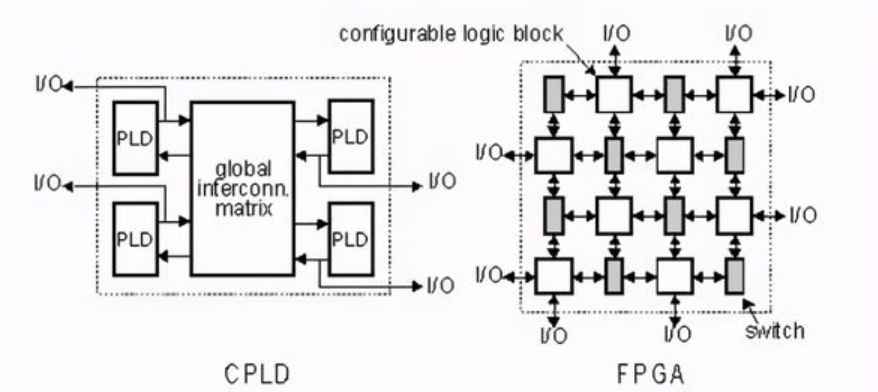
CPLD: Primarily consists of programmable logic units, interconnections, and I/O units. Its simpler structure ensures uniform and fixed timing delays, making CPLD predictable in timing performance.
FPGA: Contains Configurable Logic Blocks (CLBs), programmable I/O blocks (IOBs), and programmable interconnect matrices. Its complex structure allows for distributed, variable-length connections, offering more flexibility but also making delay times dependent on the design layout and routing.
2. Integration and Scale:
CPLD: Lower integration level, typically in the range of thousands to tens of thousands of gates, suitable for simpler logic functions.
FPGA: Higher integration, reaching hundreds of thousands of gates or more, making it capable of handling more complex logic and parallel computing tasks.
3. Application Range:
CPLD: Often used for combinational logic such as data paths and sequential logic, ideal for scenarios that require miniaturization, low power consumption, and low complexity.
FPGA: Supports both combinational and sequential logic, capable of implementing complex tasks like microprocessors and digital signal processing (DSP) algorithms. It excels in data-intensive applications such as AI, communications, and data processing, where high performance is essential.
4. Configuration and Security:
CPLD: Once programmed, retains its configuration even when powered off, eliminating the need for an external configuration chip, resulting in relatively higher security.
FPGA: Uses SRAM technology for configuration, which loses data when powered off, requiring an external configuration chip. This external dependency can slightly compromise the confidentiality compared to CPLD.
5. Programming Method and Flexibility:
CPLD: Programmed using HDLs (e.g., VHDL or Verilog), but the configuration must be loaded onto the chip after programming. It is relatively less flexible.
FPGA: Supports HDLs as well as high-level programming languages (e.g., C/C++), allowing for online programming and dynamic reconfiguration, thus offering higher flexibility.
6. Timing Delays and Power Consumption:
CPLD: Uniform and predictable timing delays due to continuous wiring structure. Its simpler design also leads to lower power consumption.
FPGA: Segmented wiring structure can result in variable delays, and the distributed structure generally consumes more power. However, FPGA's advantages in high-speed parallel processing make these drawbacks acceptable in many scenarios.
CPLD vs. FPGA: Comparison
| CPLD | FPGA |
|---|
| Definition | Complex Programmable Logic Device | Field-Programmable Gate Array |
| Structure | Includes programmable logic blocks, flip-flops, and interconnect channels | Comprises numerous programmable logic units and flip-flops, connected by programmable resources |
| Flexibility | Moderately flexible, fixed configuration | Highly flexible, supports dynamic reconfiguration |
| Scale | Small, suited for simple logic circuits | Large, suitable for complex circuit design |
| Performance | Medium performance, suitable for general logic circuits | High performance, ideal for complex logic and fast data processing |
| Power Consumption | Relatively low | Relatively high (varies with integration) |
| Timing Predictability | Consistent and predictable | Variable, depends on design |
| Applications | Control logic, state machines, simple sequential tasks | High-speed communication, image processing, DSP, and complex tasks |
When to Use CPLD or FPGA?
In fact, simply put, the fundamental difference between CPLD and FPGA is that once programmed, a CPLD retains its logic configuration permanently. It means that it can execute its programmed functions immediately upon power-up. In contrast, FPGA configurations are lost when powered off, requiring reconfiguration each time the system is powered on. Therefore, FPGAs usually need a configuration chip to reload the settings upon power-up, which can take time, unlike CPLDs that can operate immediately.
CPLDs have limited write-erase cycles ,around 100 to 1000 cycles before they wear out. On the other hand, FPGAs can be rewritten indefinitely, though technically limited, in regular use, they often outlast the need for reprogramming. FPGA configuration chips also have limited write cycles and are often OTP (one-time programmable).
CPLDs are smaller, programmed via EEPROM or Flash, while FPGAs have larger capacities, supporting more I/Os and configured through configuration files or PROM/Flash.
Considering all the above cases, we can conclude that CPLD is suitable for simple logic and high-speed situations, such as router and switch control logic, while FPGA is suitable for complex logic and high-performance requirements, such as digital signal processing and image processing. In the learning or development stage, it is best to use FPGA because it can be repeatedly erased without immediately burning. As long as you keep charging, the logical function that you burn down will always be available. After the product is finalized, the CPLD can be considered to avoid the need for FPGA. However, when the configuration capacity is very large, the CPLD cannot accommodate it, so you have to use FPGA and need to add a configuration chip to the final product (of course, you can also simulate the configuration chip).
To sum up, both FPGA and CPLD are programmable logic devices, but they differ in scale, flexibility, performance, and application scenarios. Users can select the appropriate devices according to the specific design requirements and application scenarios.