Whether connecting to WiFi, making a phone call or enjoying radio broadcasts, wireless technologies have transformed the modern world through their ability to transmit information via radio frequency (RF) electromagnetic waves. But what exactly is RF, and how does it enable all of today's important communication applications? This article will explore the underlying physics, key properties, uses and safety of this ubiquitous yet often taken-for-granted spectrum.
Properties of RF
By definition, RF refers to oscillating electric and magnetic fields within the range of around 3 kHz to 300 GHz - the rate at which these fields alternate is the frequency. RF energy naturally radiates as radio waves when generated by antennas connected to oscillating electric currents.
Propagation as Electromagnetic Waves
RF energy propagates through free space as oscillating electric and magnetic fields oriented perpendicular to each other and the direction of travel. The electric and magnetic fields vary in intensity based on the amplitude of the RF signal. Their frequency of oscillation determines the specific RF.
RF waves can transmit through air, free space, or dielectric solid/liquid materials based on their wavelengths and the mediums' electrical properties.
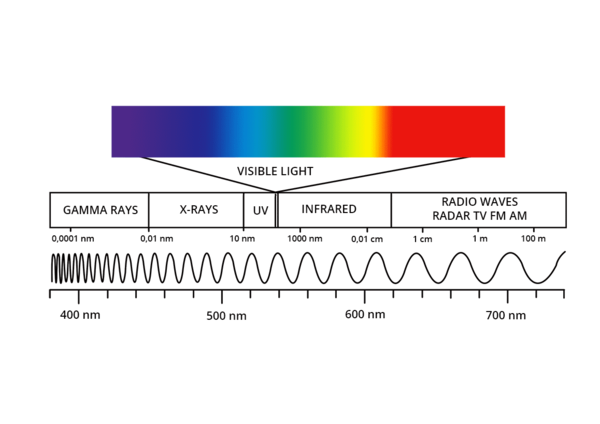
Fig.1: a Glimpse of Electro Magnetic Waves
Skin Effect
Another interesting property of RF is its tendency to flow along the surfaces of conductors, known as the skin effect. This phenomenon can result in superficial burns if exposed to high-power RF fields for extended periods. This property allows RF to heat objects without penetrating deeply. However, it is important to note that RF currents below certain thresholds do not typically cause sensations of electric shock like static electricity may. Above around 100 kHz, RF also gains the ability to ionize air molecules, seen as plasma displays light up or radio transmitters emitting visible plasma arcs.
Within conductors like metal, the oscillating electric and magnetic fields of RF energy penetrate only shallowly, concentrated in the "skin" region. This depth, called the skin depth, decreases with increasing frequency and conductor material conductivity. It defines how far RF currents efficiently flow. Skin effect is exploited in applications like waveguides to confine RF to propagate along surfaces rather than through volumes.
Interaction with Materials
In addition to heating through direct current resistance, RF currents induce polarization effects in dielectric materials. Polar molecules like water subtly re-orient toward reversing electric fields millions of times per second, absorbing power. RF energy also induces small alternating electric currents within conductors through electromagnetic induction. The interaction is frequency dependent, allowing RF spectroscopy to sense signature resonant absorption patterns for identification.
By understanding key propagation behaviors and material interactions exploited by technologies, RF properties provide insight into its diverse detection, communication and industrial applications functions.
Uses of RF
Wireless communication harnesses RF to transmit information across vast distances without wires. AM/FM radio, analog/digital television, WiFi, Bluetooth, cellular networks and GPS all operate through RF modulation schemes. RF sensing finds roles too - radar tracks objects like aircraft or weather patterns using reflected signals—industrial RF heating bakes, drying or curing materials by agitating polar molecules. The applications of RF are vast and varied. Some of the key uses of RF technologies are as follows.
Wireless Communication
Radio frequency transmissions form the basis of long-range wireless communication technologies. AM/FM radio broadcasts utilize lower RF frequencies in the kHz to MHz range to transfer audio signals across broad areas via ground wave propagation. Higher frequency RF waves in the MHz to GHz spectra facilitate modern digital data connections over shorter distances through line-of-sight transmission. Cellular networks operate via carefully partitioned RF channels, enabling billions of concurrent mobile phone calls and internet sessions worldwide without interference. Systems have evolved from original analog 1G to advanced 4G/5G standards achieving multi-gigabit data throughput. Satellite communications also transmit RF signals internationally from geostationary orbiting radio repeaters.
WiFi Networks
Unlicensed industrial, scientific and medical (ISM) RF bands allow wireless internet access points to communicate with numerous surrounding devices simultaneously. Common implementations employ IEEE 802.11 standards at 2.4GHz or 5GHz, offering throughput up to 10 gigabits per second within a local area coverage radius. Bluetooth utilizes the 2.4GHz ISM band with frequency hopping spread spectrum modulation to wirelessly connect peripherals like keyboards, mice, headphones and wireless speakers to computers or mobile phones securely over short ranges under 100 meters.
RFID Systems
Radio frequency identification technologies harness LF, UHF or microwave RF to identify tagged assets automatically. Passive RFID labels harvest minimal energy from nearby reader interrogation signals to modulate back product info. Applications range from electronically tracking merchandise in stores to electronically tolled fare payments on trains and ATM card contactless transactions.
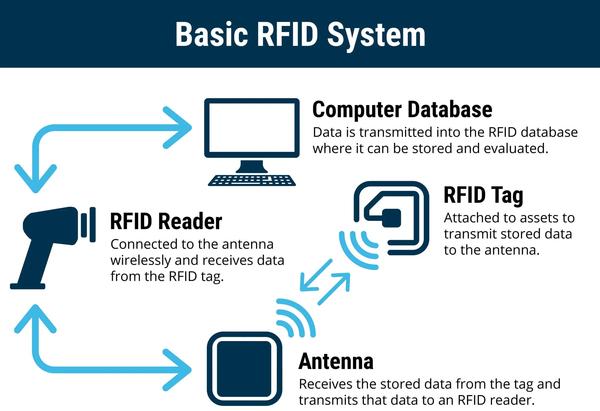
Fig.2: Basic RFID System
Sensing and Detection
RF-based sensing and detection technologies have revolutionized various industries by enabling accurate and efficient monitoring of objects and environments. Here are some key applications of RF in sensing and detection:
Radar Systems: Radar (Radio Detection and Ranging) is a well-known RF-based technology used for detecting and tracking objects. It operates by emitting RF waves and analyzing the reflections that bounce back from the target objects. Radar systems are extensively used in aviation for air traffic control, weather monitoring, and collision avoidance systems. They also find applications in maritime navigation, military surveillance, and automotive safety systems such as adaptive cruise control and collision warning systems.

Fig.3: Radar Scanning
Motion Sensors: RF motion sensors are commonly employed in security systems and automated lighting systems. These sensors work by emitting RF waves and detecting any changes in the reflected waves caused by the movement of objects or individuals. RF motion sensors are highly versatile and can be used in various settings, including homes, offices, and public spaces, to detect unauthorized access or trigger automated responses.
Material Measurement Technologies: RF technology plays a crucial role in measuring material properties such as moisture content, density, and thickness. For example, in the agriculture industry, RF-based moisture sensors are used to measure soil moisture levels, helping farmers optimize irrigation practices. In the construction industry, RF sensors can assess the density and compaction of construction materials, ensuring quality control. Similarly, RF-based thickness gauges are used in manufacturing processes to measure the thickness of materials such as plastic films, metals, and coatings.
Airport Scanners: Advanced imaging technologies used in airport security scanners, such as millimeter-wave scanners, rely on RF frequencies to detect concealed objects on passengers. These scanners emit low-power RF waves that penetrate clothing and reflect differently based on the shape and density of objects. By analyzing the reflected RF waves, security personnel can identify potential threats while respecting passengers' privacy.
RF Heating
Heating objects through RF technologies have found widespread applications in various industries, offering advantages such as rapid and efficient heating, precise temperature control, and uniformity. Here are some notable applications of RF heating:
Microwave Ovens: Microwave ovens have become a staple in modern kitchens, thanks to RF-based dielectric heating. The oven generates RF waves at a frequency of around 2.45 GHz, which is efficiently absorbed by water molecules present in food. As the water molecules absorb the RF energy, they vibrate vigorously, generating heat and cooking the food. The selective absorption of RF energy by water molecules allows for quick and uniform heating, saving time and energy compared to conventional ovens.
Industrial Processes: RF heating plays an essential role in various industrial applications, particularly those involving materials with high dielectric losses. For instance, in the plastics industry, RF energy is used in processes such as plastic welding and sealing. The RF waves generate heat within the material, enabling precise joining of plastic components without the need for adhesives or additional heating elements.
Medical Applications: RF heating has also found applications in the medical field. For instance, in physiotherapy, RF energy is used to generate heat deep within tissues, promoting blood circulation and aiding in the healing process. Additionally, RF ablation is a minimally invasive medical procedure that uses RF energy to produce heat and destroy abnormal tissues, such as tumors or cardiac arrhythmias.
Industrial Drying: In industries such as paper, textiles, and food processing, RF drying systems are employed to remove moisture from materials quickly and efficiently. RF waves selectively heat the moisture within the material, allowing for faster drying times and preserving the quality of the product. RF drying systems offer advantages such as precise control over temperature and moisture content, reduced drying times, and energy savings.
RF Technologies
RF technologies encompass a range of modulation techniques used to transmit information. Two of the most well-known modulation schemes are amplitude modulation (AM) and frequency modulation (FM). AM is used in analog radio broadcasts, where the amplitude of the RF carrier wave is modulated to encode the audio information. FM, on the other hand, is used for higher-quality audio transmission and is the standard for FM radio.
In addition to AM and FM, modern wireless data transmission relies on more complex digital modulation schemes. These schemes, such as phase-shift keying (PSK), quadrature amplitude modulation (QAM), and orthogonal frequency-division multiplexing (OFDM), allow for efficient and reliable transmission of digital information over RF channels. These technologies form the backbone of our mobile networks, Wi-Fi routers, and other wireless communication systems.
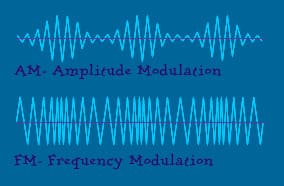
Fig.4: Oscillograms of AM and FM
Amplitude Modulation (AM)
Amplitude modulation is a modulation scheme where the amplitude of a high-frequency carrier wave is varied in proportion to the instantaneous amplitude of the modulating signal. In the case of analog radio broadcasts, the modulating signal contains the audio information that we hear, such as music or speech.
The process of AM involves combining the modulating signal with the carrier wave. The resulting modulated signal contains both the carrier wave and two sidebands, which are mirror images of each other on either side of the carrier frequency. The amplitude of the carrier wave is varied according to the modulating signal's amplitude, resulting in the modulation of the signal.
AM radio broadcasts typically use frequencies in the range of hundreds of kilohertz (kHz). The lower frequency range of AM signals allows them to propagate over long distances by utilizing the Earth's ionosphere, which reflects and refracts radio waves back to the ground. This property enables AM radio signals to cover vast areas, making them suitable for broadcasting to large regions.
However, one limitation of AM is its susceptibility to interference and noise. Since the audio information is encoded in the amplitude variations of the carrier wave, any interference or noise can affect the quality of the received signal. This is why AM broadcasts are more prone to noise, fading, and other disturbances compared to FM broadcasts.
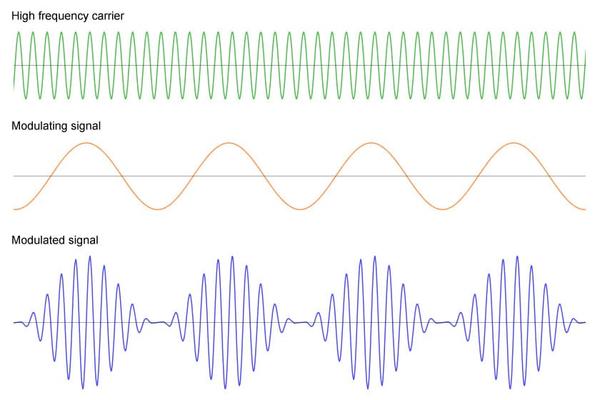
Fig.5: High frequency carrier and Modulating signal and Amplitude Modulation
Frequency Modulation (FM)
Frequency modulation is another modulation technique used in RF communication. Unlike AM, which encodes information in the amplitude of the carrier wave, FM encodes information in the carrier wave's frequency. In FM, the instantaneous frequency of the carrier wave is varied in accordance with the modulating signal.
The process of FM involves shifting the frequency of the carrier wave above and below its original frequency based on the modulating signal. This frequency deviation is directly proportional to the amplitude of the modulating signal at any given point in time. As a result, the frequency of the carrier wave carries the information, and the amplitude remains constant.
FM radio broadcasts and modern digital communication systems utilize higher frequencies in the range of hundreds of megahertz (MHz) to gigahertz (GHz). These higher frequencies allow for higher data rates and better signal quality compared to AM. FM signals are less susceptible to noise and interference, resulting in clearer audio transmission.
One advantage of FM is its resistance to amplitude variations or changes in signal strength. This property makes FM less affected by noise and interference, ensuring a higher quality audio signal. FM broadcasts are widely used for commercial radio stations, delivering high-fidelity audio to listeners.
Digital Modulation Schemes
While AM and FM are widely used in analog radio broadcasting, modern wireless communication systems rely on more complex digital modulation schemes. These schemes encode information in digital form and provide efficient and reliable transmission of data over RF channels.
Digital modulation schemes provide advantages such as better noise immunity, higher data rates, and improved spectral efficiency compared to analog modulation. They are the foundation of modern wireless communication systems, including cellular networks, Wi-Fi, Bluetooth, and satellite communications.
Incorporating these modulation techniques and digital schemes into RF communication has revolutionized the way we transmit and receive information wirelessly. The advancements in modulation technology have enabled us to enjoy high-quality audio, faster data transfer rates, and seamless connectivity in our everyday lives.
By understanding the principles behind AM, FM, and digital modulation, we can appreciate the complexity and sophistication of RF communication systems. These modulation techniques have played a crucial role in shaping our modern wireless world and continue to evolve as technology advances.
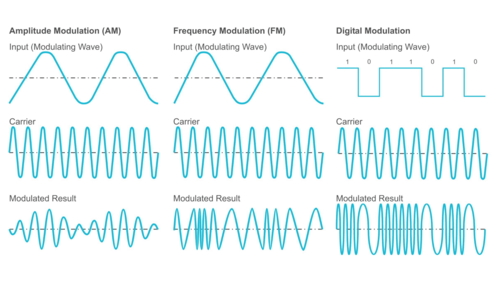
Fig.6: Oscillogram - AM vs FM vs Digital Modulation
RF Frequency Band Designations
Regulatory bodies segment the electromagnetic spectrum and assign standardized frequency ranges to applications requiring non-interfering coexistence. For example, AM radio spans 520 kHz to 1.7 MHz while FM broadcasts 88 to 108 MHz. WiFi utilizes unlicensed 2.4 and 5 GHz industrial, scientific, and medical (ISM) bands. Each tier balances coverage vs bandwidth needs.
To prevent signal interference, governing bodies divide the electromagnetic spectrum into standardized frequency allocations for different applications based on their technical needs and historical development. Some key bands include:
● Low Frequency (LF) Band (30 kHz-300 kHz) - Used primarily for AM radio broadcasting which can travel far distances on these frequencies. Channels spaced 10 kHz apart to avoid interference.
● Medium Frequency (MF) Band (300 kHz-3 MHz) - Also used for AM radio in some regions. Offers better audio quality than LF band.
● High Frequency (HF) Band (3 MHz-30 MHz) - Employed for international shortwave radio, military communications and amateur radio due to their ionospheric reflection properties enabling global propagation.
● Very High Frequency (VHF) Band (30 MHz-300 MHz) - Home to FM radio broadcasting from 88-108 MHz. The line-of-sight range makes it best for local broadcast stations. Military aviation radar also uses VHF.
● Ultra High Frequency (UHF) Band (300 MHz-3 GHz) - Houses digital television broadcasting and 4G/5G cellular networks. Microwave ovens operate at around 2.4GHz. Short range but high bandwidth.
● Super High Frequency (SHF) Band (3 GHz-30 GHz) - A portion of this band contains the globally open 5GHz WiFi channels as well as satellite downlinks. Line-of-sight but ideal for wireless internet backbones.
● Extremely High Frequency (EHF) Band (30 GHz–300 GHz) - Frontier for 6G research due to supportable bandwidths over 10 GHz while avoiding moisture absorption. Requires very directional antennas.
Careful management of these allocations minimizes clutter and allows the peaceful coexistence of important radio applications across diverse frequency-dependent transmission characteristics.
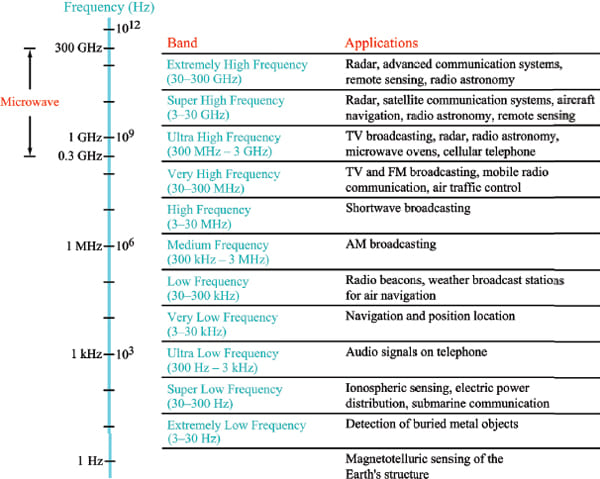
Fig.7: RF Frequency Band Designations and Applications
RF Safety
When discussing RF, safety is an important consideration. Unlike ionizing radiation such as X-rays and gamma rays, RF is non-ionizing. This means that RF does not have enough energy to break molecular bonds or cause genetic damage as ionizing radiation does, RF exposures remain classified as potentially hazardous only above strict regulatory thresholds. However, RF energy can still cause harm through heating effects at high power levels.
To ensure the safety of RF exposure, regulatory bodies such as the Federal Communications Commission (FCC) in the United States and similar agencies worldwide have established guidelines and exposure limits. These limits take into account factors such as frequency, power level, and exposure duration to mitigate any potential health risks associated with RF radiation. As with all technologies, responsible practices ensure safe, informed use of wireless capabilities.
Wrap Up
Radio frequency (RF) encompasses a range of oscillating electromagnetic fields used for wireless communication, sensing, and heating applications. Its ability to propagate over long distances and interact with materials makes it a versatile technology. Mastering RF principles sheds light on how invisible electromagnetic forces transmit data seamlessly across vast distances, transforming lives through conveying information freely through thin air. Continued RF progress opens new frontiers of innovation for improving communication, detection and societal progress in balanced, beneficial ways.